
Automotive tubing may look simple from the outside, yet its production involves a tightly controlled relationship between polymer behavior, dimensional accuracy, process monitoring, and quality records. Requirements for nylon and PA12 tubing can differ substantially from those of general-purpose pipes, especially where components are used in fuel, braking, cooling, or air-conditioning systems.
That shift changes how plastic extrusion equipment is specified: screw geometry, melt-pressure stability, downstream measurement, data collection, and process control all become part of the production-quality equation.
Dimensional Tolerances Change the Extrusion Process
Automotive tubing demands more than producing a profile that visually matches the die. Outside diameter, wall thickness, concentricity, layer distribution, and dimensional stability can all affect how a tube fits with connectors or performs inside a vehicle system. A small process fluctuation can consequently become a manufacturing concern when tubing is produced continuously at high speed.
Material behavior adds another layer of complexity. Nylon-based polymers respond to temperature, residence time, shear, and cooling conditions, so stable melt conditions are important before the material reaches the die. A pipe extrusion machine designed around general-purpose pipe production may not provide the same measurement and control architecture required by precision automotive tubing.
Downstream equipment is particularly significant. DEKUMA’s automotive extrusion solution incorporates ultrasonic wall-thickness inspection and laser diameter measurement, while high-speed traction and servo-driven cutting are used to control subsequent production stages. These technologies illustrate how dimensional control can be distributed across the entire line rather than concentrated solely at the extrusion head.
IATF 16949 Requirements Extend Beyond the Machine
IATF 16949 is oriented toward automotive quality management and incorporates customer-specific requirements into the supply-chain environment. The IATF also publishes OEM-specific requirements for manufacturers including Ford, GM, Mercedes-Benz, Stellantis, and others. This means tubing suppliers may need production systems that support documented process control rather than relying only on final-product inspection.
Such expectations influence plastic extrusion equipment because machine controls can become part of the wider manufacturing-control system. Parameters such as temperature, extrusion speed, material feed, pressure, and line synchronization need to be monitored consistently. A modular PLC architecture and real-time data logging can make production information easier to connect with internal quality procedures and process records.
The implication for machinery specification is practical: automation should be assessed according to the information it can capture, retain, and communicate. DEKUMA’s single-screw platform, for example, uses B&R or Siemens control systems with real-time data logging and gravimetric dosing control for weight-per-meter management. Those functions are relevant when production teams need greater visibility into process behavior rather than simply an automated start-and-stop sequence.
Traceability Shapes Data and Process Architecture
Traceability is not merely a labeling exercise. Automotive quality requirements include identification and traceability, with the IATF’s sub-tier automotive quality requirements specifically referencing this area under IATF 16949. Production records may need to connect material, process conditions, inspection results, and finished tubing to a defined manufacturing history.
That requirement gives the pipe extrusion machine a broader role in manufacturing data management. Sensors and control systems can provide information about operating conditions during production, while inspection equipment can identify dimensional deviations as they occur. The value lies in creating a usable chain of information rather than collecting isolated numbers that cannot be related back to a particular production period.
For nylon and PA12 tubing, this approach becomes especially useful when multilayer structures or demanding vehicle applications are involved. Material-layer control, melt stability, wall-thickness inspection, and diameter measurement can be considered together when defining the line architecture. The objective is not simply more data; it is a production record that helps engineers understand how process conditions relate to finished-tube characteristics. DEKUMA’s automotive solution reflects this integrated approach through controlled material-layer extrusion and inline dimensional inspection.
Specification Decisions Beyond Standard Pipe Applications
A conventional pipe project may place considerable emphasis on throughput, pipe diameter, material compatibility, and downstream handling. Automotive tubing introduces additional questions: What dimensional variables must be monitored continuously? Which parameters need historical records? How should multilayer structures be controlled? How quickly can an abnormal condition be identified and corrected? These questions can alter the configuration of plastic extrusion equipment before production even begins.
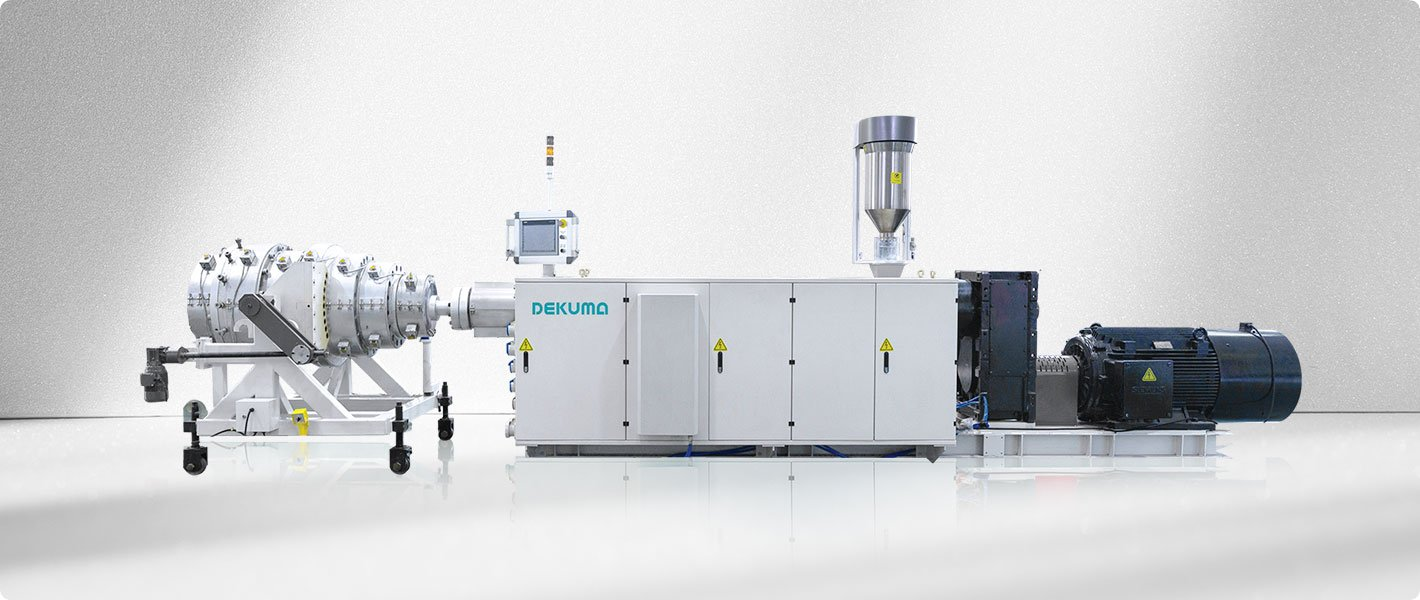
DEKUMA’s automotive extrusion technology provides a useful example of how those requirements translate into machinery design. Its automotive solution uses a precision servo drive for layer extrusion, a specialized screw design for melt-pressure and flow stability, a multilayer die head, modular temperature control, ultrasonic wall-thickness inspection, laser diameter measurement, high-speed traction, and servo-driven cutting. The equipment details demonstrate that automotive tubing specifications extend well beyond the basic extruder itself.
The same principle applies to equipment sizing and configuration. A DEKUMA single-screw platform, for instance, is available with screw diameters from 45 mm to 150 mm and L/D ratios of 33D, 36D, and 40D, with different configurations supporting different material and output requirements. Those figures should be treated as engineering inputs rather than generic performance claims; the appropriate configuration depends on the resin, tube structure, output target, and process window.
Conclusion
Automotive OEM expectations reshape extrusion machinery because quality is built into the process rather than inspected only after production. Dimensional tolerances, automotive quality systems, customer-specific requirements, and traceability each introduce technical considerations that are less prominent in many conventional pipe applications. A suitable pipe extrusion machine must consequently be evaluated as part of a controlled manufacturing system.
DEKUMA approaches automotive tubing through equipment that combines extrusion control, multilayer processing, inline measurement, downstream synchronization, and production data functions. Its role is not simply to provide an extrusion unit, but to configure machinery around the technical requirements of the intended tubing application.
When OEM specifications become increasingly detailed, machinery selection can no longer be based on output capacity alone. The more useful question is how effectively the extrusion line connects material processing, dimensional control, quality records, and production traceability into one coherent process.

Oliver Smith is an experienced blogger at Grammar Globe, Oliver Smith, an expert in English grammar and a master of wit, brings language to life with his playful take on puns. Through his works, he weaves humor into the rules of grammar, making learning fun and engaging for readers of all ages. Discover language with a smile!”