
RTV silicone sealants in construction joints, automotive assemblies, or industrial equipment must stretch and recover to keep a reliable seal over time. Polymer elongation is critical because it lets silicone absorb movement from vibration, temperature changes, and substrate expansion.
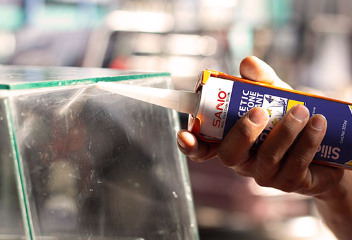
High elongation isn’t just about softer silicone. A silicone sealant manufacturer must engineer the entire formulation—from molecular design and curing behavior to application performance. SANVO studies these relationships to support silicone sealing solutions for demanding environments.
Understanding the Relationship Between Silicone Structure and Elongation
The flexibility of RTV silicone comes from its unique molecular structure. Unlike many organic polymers, silicone materials contain silicon-oxygen bonds that provide excellent chain mobility and resistance to temperature changes.
During formulation development, engineers evaluate how silicone polymer chains move under external force. Longer molecular chains generally provide greater flexibility because they can absorb more mechanical energy before breaking. This characteristic directly influences how much the cured sealant can stretch.
However, polymer length alone does not influence final performance. The arrangement of molecular groups, polymer distribution, and interaction between different ingredients all affect the elasticity of the finished product.
A well-balanced silicone structure allows the sealant to deform when pressure is applied and recover after the stress disappears. This recovery capability is especially important for applications where joints experience repeated movement rather than one-time stretching.
Formulation Decisions That Influence Elastic Recovery
High elongation and strong recovery ability are closely connected but are not identical properties. A material may stretch significantly but fail to return to its original shape if the internal structure is not properly designed.
RTV silicone formulation requires precise control of the elastic network created during curing. This network acts like a flexible framework that holds polymer chains together while still allowing movement.
If the network becomes too dense, the silicone may become rigid and lose its ability to absorb displacement. If the structure is too loose, the material may lack strength and become vulnerable to tearing or permanent deformation.
Manufacturers adjust curing chemistry and component ratios to create the right balance. The objective is to achieve a sealant that can handle repeated stretching without sacrificing durability during long-term service.
The Impact of Material Compatibility on Silicone Performance
A successful RTV silicone formula depends on how different ingredients work together. Polymer, reinforcing materials, curing agents, and performance additives must remain compatible throughout processing and after curing.
Poor compatibility between components can create uneven internal structures. These weak points may reduce elongation and increase the risk of failure when the sealant experiences mechanical stress.
Material dispersion is another important consideration. Reinforcing ingredients must be distributed evenly throughout the silicone matrix. Proper dispersion improves strength while preserving the flexibility required for movement absorption.
A silicone sealant manufacturer must therefore evaluate not only individual raw materials but also their combined influence on the final cured product.
Why Processing Conditions Affect Final Elongation Results
Even a carefully designed silicone formula can produce inconsistent results if manufacturing conditions are not properly controlled. Production parameters directly affect the uniformity and stability of the finished sealant.
Mixing speed, temperature control, moisture management, and storage conditions can influence how ingredients interact during manufacturing. Small variations may change curing behavior and create differences in mechanical properties.
For industrial customers, consistency between batches is essential. A sealant that performs well in laboratory testing must also maintain the same elongation and adhesion characteristics during large-scale production.
Reliable manufacturers use strict process monitoring and performance testing to identify variations before products reach the market.
Matching Silicone Elongation to Real Application Requirements
A common mistake in silicone selection is choosing a product based only on the highest elongation value. In practical applications, the best sealant is not always the one with the largest stretch capability.
Different environments create different performance demands. Exterior building joints require resistance against weather exposure and temperature cycles. Automotive applications may require vibration resistance and strong adhesion to various materials. Industrial equipment may need stability under continuous mechanical movement.
The formulation must match the working conditions rather than focus on a single specification. Engineers consider movement range, substrate type, environmental exposure, and service life expectations when developing suitable RTV silicone solutions.
This application-based approach prevents performance problems caused by using a material that is flexible but unsuitable for the actual operating environment.
Testing Methods Used to Verify Polymer Elongation Performance
Before an RTV silicone sealant is introduced into commercial applications, manufacturers evaluate multiple performance indicators. Elongation testing provides information about stretching capability, but it is only one part of a complete quality assessment.
Tensile strength testing helps influence whether the material can withstand pulling forces without failure. Adhesion testing confirms whether the sealant remains securely attached to different surfaces. Aging tests evaluate how environmental exposure affects flexibility over time.
Combining these tests provides a clearer understanding of real-world performance. A silicone sealant that maintains elasticity after prolonged exposure is more valuable than one that only achieves high initial elongation.
Developing RTV Silicone With Long-Term Reliability
Creating high-elongation RTV silicone requires continuous optimization rather than a single formulation adjustment. Every ingredient choice and manufacturing step contributes to the final balance between flexibility, strength, and durability.
For customers selecting suppliers, formulation expertise is a key factor because different applications often require customized performance characteristics. A manufacturer with strong technical knowledge can develop silicone products that meet specific movement, environmental, and bonding requirements.
By focusing on complete material performance instead of isolated properties, RTV silicone solutions can provide more reliable sealing results and longer service life.
Conclusion
Superior polymer elongation in RTV silicone comes from careful control of molecular structure, curing design, ingredient compatibility, and production quality. The best-performing sealants are created by balancing flexibility with mechanical strength and environmental resistance.
Modern sealing applications demand materials that hold up under challenging conditions—a reality that guides SANVO‘s approach to silicone product development. Through advanced formulation techniques and quality-focused manufacturing, these products achieve the durability and elasticity required for construction, automotive, and industrial use.
